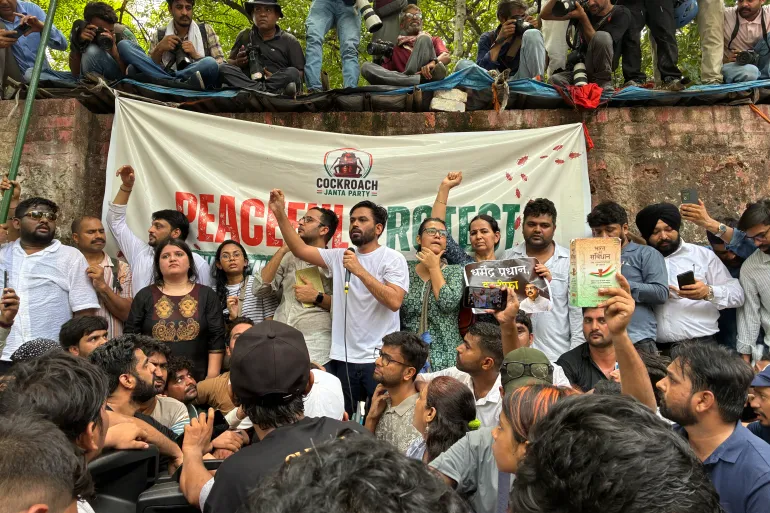
A youth-led protest movement known as the Cockroach People’s Party has gained momentum in India, with demonstrators gathering in New Delhi over education concerns.
A growing youth protest movement in India gathered in New Delhi over the weekend, as hundreds of students and young activists demanded accountability from the government over education-related issues.
The movement, known as the Cockroach Janata Party (CJP), began as a satirical online campaign but has quickly evolved into a wider protest platform driven largely by India’s younger generation.
Among those attending the demonstration was 17-year-old Saurav Kushwaha, who traveled overnight from the central Indian state of Madhya Pradesh along with his elder brother to join the gathering in the capital.
The protests reflect rising frustration among young Indians over repeated controversies involving examination paper leaks, alleged irregularities in school board systems, and concerns about the country’s education structure.
The unusual name of the movement emerged after comments made by India’s chief justice last month, which many young people interpreted as comparing youth to “cockroaches.” The remarks triggered strong reactions online and inspired social media discussions that eventually led to the creation of the CJP movement.
The campaign was largely popularized by Abhijeet Dipke, a recent graduate from Boston University, who posted online asking: “What if all cockroaches came together?”
What started as an internet joke soon gained massive traction across social media platforms. The movement reportedly attracted tens of millions of followers online, rapidly becoming one of India’s most talked-about youth-driven digital campaigns.
The name Cockroach Janata Party is also seen as a satirical reference to Prime Minister Narendra Modi’s Bharatiya Janata Party (BJP), which has governed India since 2014.
However, organizers insist the movement has now moved beyond satire and is focused on real political and educational concerns.
Addressing the crowd in New Delhi, Dipke called on the government to remove the education minister and warned that demonstrations would continue until action is taken.
Observers say the protests highlight broader frustration among India’s younger population, which represents nearly half of the country’s 1.4 billion citizens.
Political analysts believe social media has played a major role in transforming online anger into organized street demonstrations, especially among Gen Z voters increasingly vocal about employment, education, and governance issues.
The government has not yet officially responded to the latest protest movement or its demands.