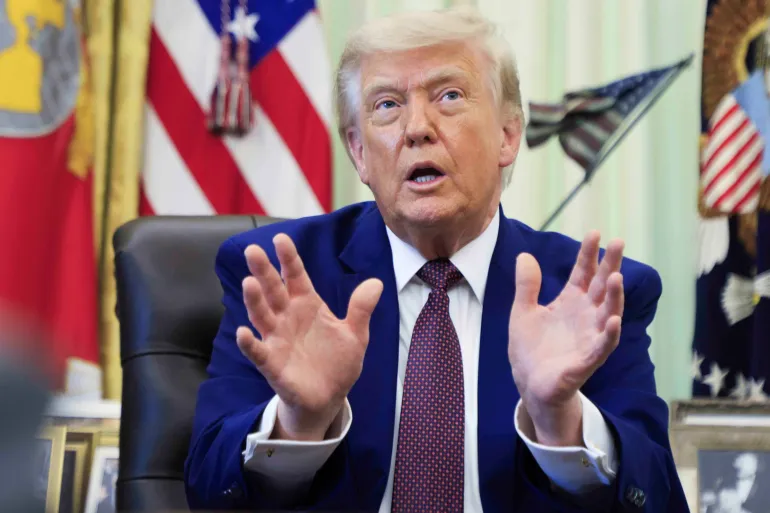
Donald Trump criticized Republican lawmakers who supported a House resolution aimed at limiting his authority to continue military action against Iran.
United States President Donald Trump has sharply criticized members of Congress, including several Republicans, after the House of Representatives approved a resolution aimed at restricting his ability to continue military action against Iran without additional congressional approval.
The vote took place on Wednesday, when the House passed a war powers resolution by a narrow margin of 215 to 208. Four Republican lawmakers joined Democrats in supporting the measure, allowing it to pass after several previous failed attempts.
The resolution seeks to reinforce Congress’s constitutional authority over declarations of war and would require further approval before prolonged military operations against Iran could continue.
Reacting on Thursday through his social media platform Truth Social, Trump accused lawmakers of undermining ongoing diplomatic efforts with Iran.
The president argued that the vote came at a critical moment during negotiations aimed at securing a ceasefire and broader agreement with Tehran. He described the move as “unpatriotic” and criticized Republican lawmakers who broke ranks with his administration.
Among those singled out by Trump were Republican representatives Thomas Massie of Kentucky, Tom Barrett of Michigan, Warren Davidson of Ohio, and Brian Fitzpatrick of Pennsylvania.
Trump also dismissed the House resolution as largely symbolic and accused the lawmakers of seeking political attention.
The latest dispute comes amid continuing tensions between Washington and Tehran, as negotiations over Iran’s nuclear program and regional security issues remain stalled. Although both sides have discussed the possibility of a diplomatic breakthrough, recent weeks have also seen military exchanges and rising regional instability.
One of the major sticking points in negotiations remains Iran’s nuclear activities and control over the Strait of Hormuz, a strategically important shipping route for global energy supplies.
Political analysts say the House vote may reflect growing divisions within the Republican Party ahead of the upcoming midterm elections, with some lawmakers increasingly cautious about prolonged military involvement overseas.
Despite the House approval, the resolution still faces significant obstacles before becoming law. It would need to pass the Republican-controlled Senate and survive a likely presidential veto, requiring a two-thirds majority in both chambers to override.
Supporters of the measure argue that the US Constitution gives Congress the primary authority to declare war. Advocacy groups and legal experts have also cited the War Powers Act of 1973, which limits a president’s ability to continue military operations without congressional authorization beyond a set period.
Several organizations welcomed the House vote and urged the Senate to take similar action, arguing that extended military conflict could further damage the global economy and increase costs for American consumers through rising fuel and commodity prices.
Recent public opinion polls have suggested growing concern among American voters over the conflict, with critics warning that continued escalation could have serious political and economic consequences.