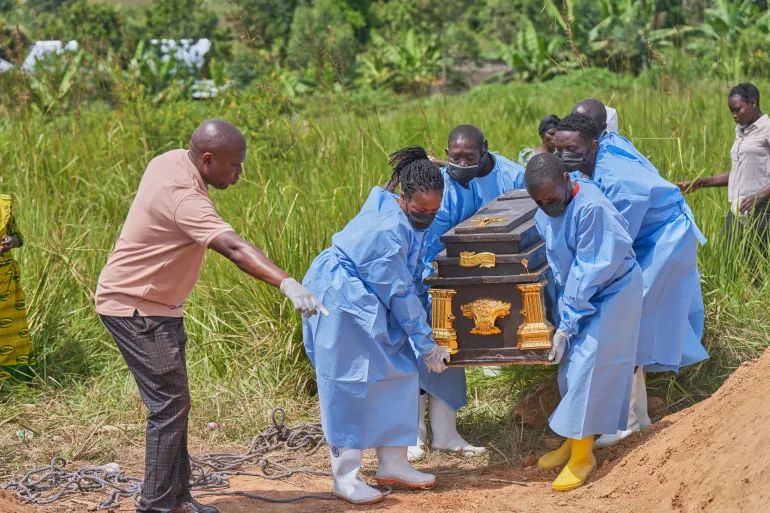
Ebola cases in the Democratic Republic of the Congo rise sharply to 782 infections and 181 deaths as officials warn of worsening outbreak conditions.
The Ebola outbreak in the Democratic Republic of the Congo (DRC) has worsened sharply, with health authorities reporting a record daily rise in infections and a rising death toll.
According to the country’s Ministry of Public Health, 72 new cases were confirmed within a 24-hour period, bringing the total number of infections to 782. Officials also reported 32 additional deaths, raising the total fatalities to 181.
Health authorities say the rapid increase in cases reflects growing challenges in controlling the outbreak, including insecurity in affected regions, difficulties in tracing contacts, and occasional escapes of infected patients from treatment centres.
The outbreak is linked to the rare Bundibugyo strain of Ebola, which has a reported fatality rate of about 22.8 percent. So far, 40 patients have recovered.
Unlike the more commonly known Zaire strain, which has been responsible for previous Ebola outbreaks in the DRC, the Bundibugyo strain currently has no approved vaccine or specific treatment, complicating response efforts.
Strained response efforts
Public health officials and international organisations warn that containment measures are under significant pressure. Contact tracing coverage has dropped to around 56.5 percent, far below the 95 percent target required for effective outbreak control.
Jean Kaseya, director general of the Africa Centres for Disease Control and Prevention, called for urgent mobilisation of resources to strengthen the response and prevent further loss of life.
Medical humanitarian organisation Doctors Without Borders (MSF) has also warned that the true scale of the outbreak may be larger than reported due to gaps in surveillance, testing, and reporting systems.
Epicentre in conflict-affected region
The outbreak is primarily concentrated in eastern DRC’s Ituri province, which accounts for the vast majority of confirmed cases. Health authorities say the virus has also spread to North Kivu and South Kivu, and across the border into Uganda.
The region is already facing a severe humanitarian crisis driven by armed conflict involving multiple armed groups, including the M23 rebel movement. Widespread violence has displaced large numbers of civilians, further complicating outbreak control efforts.
Mining activity in the region has also been identified as a potential factor in the spread of the virus. Thousands of artisanal miners frequently move between remote and informal mining sites, creating conditions that make monitoring and containment difficult.
Funding gaps and global concern
The World Health Organization has increased testing and surveillance support in affected areas, but aid organisations warn that funding shortfalls are limiting the response.
MSF has identified a funding gap of approximately $21.5 million, raising concerns about the capacity to sustain emergency medical operations.
Health experts warn that without improved surveillance, stronger security, and increased funding, the outbreak could continue to expand into new areas in the coming weeks.
The situation remains under close observation as authorities attempt to contain one of the most serious Ebola flare-ups in recent years.